UPDATED Investment Analysis: Galaxy Digital Inc. (Nasdaq: GLXY)
Original report: April 26, 2026 Update / rerun date: May 19, 2026 Analyst: Cipher Research Update framing: This is explicitly an updated rerun of the original public report. It preserves the original thesis, adds new filings/news/market data through May 19, 2026, and calls out what changed.
Updated Verdict: Watchlist / Selective Buy on Weakness Updated Score: 52/100 (up from 48/100) Confidence: Medium Buy now or wait? Wait for a better entry unless you need strategic exposure now. At roughly $27.87, Galaxy is more de-risked than the April report because Q1 results are filed, Helios has delivered its first data hall, cash/stablecoins remain large, and Nasdaq is now the sole listing. But it is also still a high-beta, crypto-linked, execution-heavy equity trading around 3.0x book and about $10.9B market cap after a strong YTD move. A staged starter position is defensible below the current tape; the cleaner risk/reward is on pullbacks toward $24-25 or after Q2 confirms Helios revenue ramp and balance-sheet stability.
What Changed Since the Original April 26 Report
| Area | April 26 view | May 19 update | Investment impact |
|---|---|---|---|
| Public listing / liquidity | Nasdaq listing already recognized, but dual-listing/transition still part of narrative | Galaxy completed voluntary TSX delisting and consolidated on Nasdaq as sole exchange per Q1 release | Cleaner U.S. public-market access, better institutional screenability |
| Q1 2026 financials | Original relied mainly on FY2025 and April market data | Q1 2026 now filed/released: $(216)M net loss, $(188)M adjusted EBITDA, $2.8B total equity, $2.6B cash/stablecoins | Confirms crypto mark-to-market volatility, but liquidity remains strong |
| Helios execution | Helios thesis was plausible but still heavily forward-looking | Galaxy says first data hall was delivered to CoreWeave in April 2026 and Phase I remains on budget/schedule for substantially all 133 MW by end-Q2 2026 | Meaningful de-risking of the AI infrastructure leg |
| Power capacity | 1.6+ GW approved power was identified as core optionality | ERCOT approval for additional 830 MW is now integrated into filed/Q1 materials; remaining 830 MW available to contract | Optionality improved, but monetization still uncontracted |
| Market price / valuation | Prior close around mid-$20s; score 48/100 | Snapshot price $27.87, market cap $10.9B, EV $9.4B, 52-week range $16.43-$45.92, YTD return 12.6% | Upside exists to sell-side targets, but margin of safety is not obvious |
| Recommendation | Watch / selective buy at lower prices | Still selective, slightly more constructive due to execution proof | Score moves from 48 to 52, but not enough for a clean buy |
Sources Reviewed for This Update
- Galaxy Q1 2026 financial results press release
- Galaxy FY2026 Q1 Form 10-Q filed May 8, 2026
- Galaxy FY2025 Form 10-K filed February 26, 2026
- Galaxy announcement of Nasdaq listing intent
- Galaxy ERCOT 830 MW Helios approval announcement
- Galaxy Helios $1.4B project financing announcement
- Galaxy April 2026 market commentary
- Yahoo Finance / yfinance market-data snapshot captured May 19, 2026
- The Motley Fool Q1 2026 earnings-call transcript
Recent Market Update
The post-original-report news flow is mixed but incrementally positive. The negative: Galaxy reported a Q1 2026 GAAP net loss of $216M, driven mainly by unrealized mark-to-market losses on digital assets, and firm-wide adjusted EBITDA of negative $188M. The positive: adjusted EBITDA losses narrowed from Q4, Galaxy retained $2.6B of cash and stablecoins, repurchased 3.2M Class A shares for $65M, delivered the first Helios data hall to CoreWeave in April, and reaffirmed Phase I delivery timing for substantially all 133 MW of critical IT load by end-Q2 2026. The update therefore raises execution confidence but does not eliminate the core underwriting problem: this remains a levered, high-beta hybrid of crypto balance sheet, institutional digital-asset platform, and AI data-center developer.
Section 1: Summary of the Opportunity
Galaxy Digital is a public financial-infrastructure and AI-infrastructure company with two investment stories under one ticker: institutional digital assets and the Helios AI/HPC data center campus. The updated case is more credible than it was in April because Helios has moved from construction promise toward initial revenue-generating operations with CoreWeave, while Galaxy remains liquid enough to absorb crypto-market volatility.
Structured snapshot:
| Metric | Updated figure / view |
|---|---|
| Ticker | Nasdaq: GLXY |
| Price snapshot | $27.87 |
| Market cap | $10.9B |
| Enterprise value | $9.4B |
| 52-week range | $16.43-$45.92 |
| Q1 2026 net income | $(216)M loss per Galaxy Q1 release |
| Q1 2026 adjusted EBITDA | $(188)M |
| Q1 liquidity | $2.6B cash and stablecoins |
| Q1 total equity | $2.8B |
| Updated verdict | Watchlist / Selective Buy on Weakness |
| Updated score | 52/100 |
Bottom line: Galaxy is no longer just a crypto operating company with a data-center story attached. Helios is becoming a real infrastructure asset. But current valuation and volatility still argue for patience rather than chasing.
Section 2: Market Opportunity Analysis
Galaxy’s market opportunity spans three large but volatile categories:
| Market | Opportunity | Evidence quality | Cipher view |
|---|---|---|---|
| Institutional digital assets | Trading, lending, staking, ETFs, custody, tokenization | Moderate to strong, supported by Galaxy segment disclosures and market commentary | Large market, but earnings remain cyclical and balance-sheet sensitive |
| AI/HPC data centers | Power-ready hyperscale compute sites | Strong for Helios capacity, weaker for long-term economics beyond contracted CoreWeave load | Biggest upside driver if Galaxy executes and signs additional tenants |
| Asset management / staking | ETFs, alternatives, validator infrastructure | Moderate, Q1 disclosed about $5.0B AUM and $3.2B assets under stake | More durable than trading, but still tied to crypto prices |
Independent market validation is directionally strong: AI data-center power demand remains supply constrained, and institutional crypto infrastructure has improved after spot ETF adoption. The risk is not market size. The risk is whether Galaxy captures economics without taking excessive financing, concentration, and commodity-price exposure.
Section 3: SWOT Analysis
| Strengths | Weaknesses |
|---|---|
| Helios has over 1.6 GW approved gross power capacity and a CoreWeave anchor tenant, per Galaxy filings/releases. | Q1 2026 still produced $(216)M GAAP loss and $(188)M adjusted EBITDA, showing earnings volatility. |
| Liquidity remains meaningful at $2.6B cash/stablecoins as of Q1 2026. | High beta of 3.65 and crypto mark-to-market exposure make entry timing unusually important. |
| Nasdaq-only listing improves public-market access versus the older TSX/Nasdaq transition. | Helios introduces project-finance, construction, power, tenant-concentration, and operating risks outside Galaxy’s original crypto core. |
| Institutional platform breadth, trading, lending, staking, asset management, GK8/self-custody, provides multiple revenue lines. | Public investors must underwrite a complex hybrid business, which can remain discounted or misunderstood. |
| Opportunities | Threats |
|---|---|
| Additional 830 MW approved but not yet contracted could become a second wave of value creation. | A crypto drawdown can hit revenue, asset values, sentiment, and access to capital simultaneously. |
| BlackRock selecting Galaxy as an approved validator for a staked Ethereum product supports institutional credibility, per Galaxy Q1 release. | CoreWeave concentration at Helios creates counterparty and timing risk. |
| Sell-side consensus target around $42 implies upside if execution continues. | AI data-center capex cycles can turn if GPU/cloud demand, power costs, financing markets, or tenant economics weaken. |
Section 4: Competitive Landscape
Galaxy competes across several partially overlapping markets rather than one clean peer set.
| Peer / comp | Primary overlap | Why it matters |
|---|---|---|
| Coinbase | Institutional crypto, custody, staking, exchange economics | More liquid and simpler public comp, but less direct AI data-center optionality |
| Circle | Stablecoin infrastructure | Cleaner stablecoin exposure, less trading/balance-sheet volatility |
| Core Scientific | Power/data-center/compute infrastructure | More direct data-center/mining comp, but Galaxy’s CoreWeave lease is a different institutional setup |
| Hut 8 | Power / compute / mining hybrid | Similar hybrid narrative, high volatility and execution risk |
| Traditional prime brokers / asset managers | Institutional trading, ETFs, custody | Incumbents can compress margins as crypto becomes normalized |
Competitive intensity: Red-to-amber ocean. Galaxy’s differentiated angle is the unusual combination of institutional digital assets and AI/HPC power infrastructure. The moat is not proven yet; it depends on executing Helios and turning the crypto platform into recurring institutional economics.
Section 5: Risk Analysis
| Risk | Likelihood | Impact | Updated mitigation / trigger |
|---|---|---|---|
| Crypto-market drawdown hits earnings and book value | High | High | Q1 already showed this with a $216M loss; require balance-sheet resilience and lower entry price |
| Helios construction / commissioning delay | Medium | High | First data hall delivered, but full 133 MW Phase I timing remains a near-term check |
| CoreWeave tenant concentration | Medium | High | Monitor CoreWeave credit, utilization, contract economics, and delivery milestones |
| Leverage and project-finance covenants | Medium | High | Q1 liquidity helps, but project-finance restrictions reduce flexibility |
| Valuation / high beta | High | Medium | Avoid chasing; use staged entries and pullback discipline |
| Regulatory shifts in digital assets | Medium | Medium | Nasdaq listing and institutional partners help, but rules remain fluid |
| Complexity discount | High | Medium | Investors may struggle to value crypto plus data centers in one company |
Section 6: Team Evaluation
Michael Novogratz remains the key-person asset and key-person risk. The positive case is clear: he built Galaxy into one of the few public institutional digital-asset platforms with credible capital-market access and a real infrastructure pivot. The negative is equally clear: Galaxy’s founder/control profile, complex structure, and balance-sheet exposure mean public holders are underwriting management judgment heavily.
Credibility score: 4/5. High domain credibility, strong capital-market relationships, and evidence of execution at Helios. Deduct for complexity, founder/control concentration, and the need to prove operational data-center execution at scale.
Section 7: Financial and Valuation Assessment
Galaxy’s updated financial profile is better described as liquid but volatile, not “cheap.”
| Metric | Updated view |
|---|---|
| Q1 2026 net loss | $(216)M |
| Q1 2026 adjusted EBITDA | $(188)M |
| Q1 2026 cash/stablecoins | $2.6B |
| Q1 2026 total assets | $10.0B |
| Q1 2026 total liabilities | $7.2B |
| Q1 2026 total equity | $2.8B |
| Market cap snapshot | $10.9B |
| Enterprise value snapshot | $9.4B |
| Price/book | 3.0x |
| Forward P/E from Yahoo/yfinance | 230.6x, not a reliable standalone valuation metric because earnings are volatile |
Interpretation: The price is not obviously excessive if Helios becomes a durable, long-term AI infrastructure cash-flow asset. It is not obviously cheap either, because public holders are paying a premium to book while absorbing crypto volatility and project-execution risk. The upgraded score reflects Helios progress, not a broad valuation re-rating.
Buy-now-vs-wait framework:
| Investor stance | Action |
|---|---|
| Long-term strategic exposure to crypto + AI power infrastructure | Buy a partial starter only; reserve capital for volatility |
| Valuation-sensitive public-equity investor | Wait for $24-25 or confirmed Q2 Helios revenue ramp |
| Short-term trader | Do not underwrite from fundamentals alone; beta is too high |
| Existing holder from lower prices | Hold; trim only if position sizing is too large after rebound |
Section 8: Go-to-Market Strategy and Traction
Galaxy’s GTM is institutional, not consumer-led. The updated traction evidence is stronger in infrastructure than in pure crypto operations.
| Traction item | Evidence | Quality |
|---|---|---|
| First Helios data hall delivered to CoreWeave | Galaxy Q1 release | Strong company-disclosed evidence |
| Phase I 133 MW target by end-Q2 2026 | Galaxy Q1 release | Moderate, still forward-looking |
| $5.0B AUM and $3.2B assets under stake | Galaxy Q1 release | Strong for point-in-time scale, volatile with asset prices |
| BlackRock validator selection | Galaxy Q1 release | Strong reputational validation, economics not disclosed |
| Nasdaq-only listing | Galaxy Q1 release / SEC filings | Strong structural improvement |
Section 9: Additional Considerations
- Regulatory: Digital assets remain exposed to securities, banking, staking, custody, and tokenization rule changes.
- Power/grid: ERCOT approval is valuable but does not remove grid, construction, interconnection, or political risks.
- Counterparty: CoreWeave is the anchor tenant. That is validation and concentration at the same time.
- Exit / upside path: Public-market upside likely comes from Helios revenue confirmation, additional tenant contracts for the remaining 830 MW, broader AI-infrastructure comps, and calmer crypto markets.
- Ethics / ESG: Power-intensive AI infrastructure and crypto exposure may face scrutiny over energy sourcing, grid stress, and environmental impact.
Section 10: Research and External Validation
Claims supported externally:
- Galaxy filed Q1 2026 results and reported a Q1 net loss, negative adjusted EBITDA, $2.6B cash/stablecoins, and $2.8B total equity.
- Galaxy states Helios delivered its first CoreWeave data hall and remains on schedule for substantially all 133 MW by end-Q2 2026.
- ERCOT approval expanded Helios approved gross power capacity to over 1.6 GW.
- The market-data snapshot supports high volatility: beta 3.65, 52-week range $16.43-$45.92.
Claims contradicted or softened:
- “Data-center pivot eliminates crypto cyclicality” is false. Q1 losses were still driven by digital-asset price depreciation.
- “Helios optionality is fully priced/contracted” is too strong. The remaining 830 MW is approved but still requires contracts, financing, and execution.
- “Consensus Buy equals low risk” is false. Analyst targets do not remove balance-sheet and beta risk.
Information gaps:
- Exact long-term margins for CoreWeave/Helios leases.
- Tenant diversification plan for the remaining 830 MW.
- Detailed data-center operating expense profile after full commissioning.
- Updated definitive proxy ownership table after the 2026 proxy is filed.
- Segment-level recurring versus trading/mark-to-market earnings split over several quarters.
Section 11: Investment Recommendation
Verdict: ⚠️ Needs More Info / Watchlist, selective buy only on weakness Confidence: Medium Updated score: 52/100
Top 3 reasons to invest / continue diligence:
- Helios is becoming real: first CoreWeave data hall delivered and Phase I target reaffirmed.
- Rare public-market exposure: Galaxy offers combined institutional digital assets and AI power infrastructure in one Nasdaq-listed vehicle.
- Liquidity buffer: $2.6B of cash/stablecoins gives Galaxy room to absorb volatility and fund near-term execution.
Bottom 3 reasons to stay skeptical:
- Q1 still lost money: negative adjusted EBITDA and GAAP losses show crypto sensitivity remains central.
- Entry price matters: at roughly $27.87, upside exists but the risk/reward is not clean enough to chase.
- Helios is concentrated and capital intensive: CoreWeave execution is a major positive, but also a major dependency.
Priority diligence questions:
- What revenue, gross margin, and EBITDA contribution will Phase I Helios produce once the full 133 MW is delivered?
- What exact economics apply to the remaining CoreWeave phases and any future tenants?
- How much incremental equity or debt is needed to monetize the remaining 830 MW?
- What happens to liquidity and covenants in a 30-50% crypto-market drawdown?
- How much of Digital Assets gross profit is recurring versus trading/mark-to-market sensitive?
- Will management prioritize buybacks, Helios capex, or balance-sheet conservatism?
- What ownership/voting-power table will the 2026 proxy disclose after the Nasdaq/Delaware reorganization?
Action call: Hold if already owned. For new money, wait for either a pullback toward $24-25 or Q2 confirmation that Helios revenue is ramping as promised. If buying now, size as a starter, not a full position.
Section 12: Cap Table Analysis & Dilution Modeling
Galaxy’s public cap table is unusual because Class A common shares trade publicly while Class B shares preserve legacy/convertible economics.
| Item | Latest disclosed data |
|---|---|
| Class A shares outstanding | 191.9M as of Q1 2026 balance sheet |
| Class B shares outstanding | 198.4M as of Q1 2026 balance sheet |
| Authorized Class A | 2.0B |
| Authorized Class B | 500.0M |
| Q1 share repurchases | 3.2M Class A shares for $65M |
| Insider ownership via yfinance | about 2.5% of listed share data, approximate and not a substitute for proxy voting analysis |
| Institutional ownership via yfinance | about 80.6%, approximate |
Public-holder implication: Repurchases modestly offset dilution, but the larger issue is governance/control and future equity financing. The FY2025 10-K states the founder controls a significant portion of voting power and that substantial future sales of Class A shares could pressure the stock. Exact post-reorganization beneficial ownership should be rechecked once the definitive 2026 proxy is available.
Section 13: Founder Deep-Dive
Mike Novogratz is not a startup founder being assessed for first-time fit; he is the controlling public-company founder/operator whose capital allocation governs the thesis. His strengths are institutional crypto credibility, capital-raising ability, and the willingness to pivot Galaxy into AI infrastructure before the public market had fully recognized the asset. The risks are founder dependence, a complex investment-company-like balance sheet, and aggressive expansion into capital-intensive infrastructure.
Founder/governance conclusion: founder quality is a net positive, but public investors should demand a margin of safety because decision concentration and business complexity are high.
Section 14: Quantitative Scoring Model
| Dimension | Weight | Prior score | Updated score | Rationale |
|---|---|---|---|---|
| Team | 25% | 7 | 7 | Strong founder/domain credibility, still key-person/control risk |
| Market | 20% | 7 | 8 | AI power + institutional crypto opportunity remains large |
| Traction | 20% | 4 | 5 | Helios first data hall delivery improves evidence quality |
| Financials | 15% | 3 | 3 | Q1 loss and negative EBITDA keep score low despite liquidity |
| Competitive | 10% | 4 | 5 | Nasdaq/liquidity and Helios differentiation improved |
| Risk Profile | 10% | 3 | 3 | Volatility, leverage, execution, and concentration remain high |
Formula result: (7×2.5) + (8×2.0) + (5×2.0) + (3×1.5) + (5×1.0) + (3×1.0) = 56.0. Cipher applies a 4-point haircut for extreme beta, still-negative EBITDA, and tenant concentration.
Final updated score: 52/100.
Interpretation: Borderline / watchlist. More attractive than April, still not a clean invest.
Section 15: Stage-Specific Benchmarking
Galaxy is a public company, so private SaaS benchmarks are not the right primary yardstick. Still, the benchmark lesson is useful: recurring, predictable, high-margin economics deserve premium multiples; volatile trading/mark-to-market earnings do not.
| Benchmark lens | Galaxy comparison |
|---|---|
| Public financial platform | Scale is meaningful, but earnings are volatile and crypto-linked |
| Public infrastructure developer | Helios is promising, but operations are early and capital intensive |
| SaaS-style recurring revenue | Not enough disclosure yet to underwrite LTV/CAC/NDR-style economics |
| Burn multiple | Not applicable in SaaS form; negative adjusted EBITDA and capex intensity are the relevant warning signs |
Section 16: Comparable Transactions Analysis
| Comparable | Category | Relevance | Valuation lesson |
|---|---|---|---|
| Coinbase | Public crypto infrastructure | Institutional crypto/custody/asset exposure | Cleaner comp but different exchange economics |
| Circle | Public stablecoin infrastructure | Institutional crypto rails | More focused exposure, less data-center optionality |
| Core Scientific | Data center / mining infrastructure | Power conversion and AI/HPC infrastructure | Shows market rewards power assets, but leverage matters |
| Hut 8 | Power / compute / mining hybrid | Similar hybrid narrative | High volatility and execution risk remain common |
| Private AI data-center financings | Hyperscale infrastructure | Helios optionality | Tenant quality and contracted power drive value |
Section 17: Unit Economics Deep-Dive
Galaxy does not disclose SaaS-style CAC, LTV, NDR, or Magic Number, and those metrics are not the right primary framework for the business. The correct unit-economic lens is segment-specific:
| Segment | Unit-economic question | Current answer |
|---|---|---|
| Digital Assets | What share of gross profit is recurring versus trading/mark-to-market? | Insufficient disclosure over time; Q1 confirms sensitivity to asset prices |
| Asset Management / staking | What are fee margins and retention of AUM/assets under stake? | $5.0B AUM and $3.2B assets under stake disclosed, but economics need more detail |
| Helios / Data Centers | What revenue and EBITDA per MW after commissioning? | Most decisive missing metric; first data hall delivery is positive but not enough |
| Corporate / Treasury | How much balance-sheet exposure is strategic versus speculative? | Net digital-asset/investment exposure fell to $1.36B in Q1, but remains material |
Unit-economics conclusion: The report cannot underwrite a full-position buy until Helios revenue/MW economics and recurring digital-asset platform margins are clearer.
Public-Market Appendix
Trading Snapshot
| Metric | Value |
|---|---|
| Last price snapshot | $27.87 |
| Market cap | $10.9B |
| Enterprise value | $9.4B |
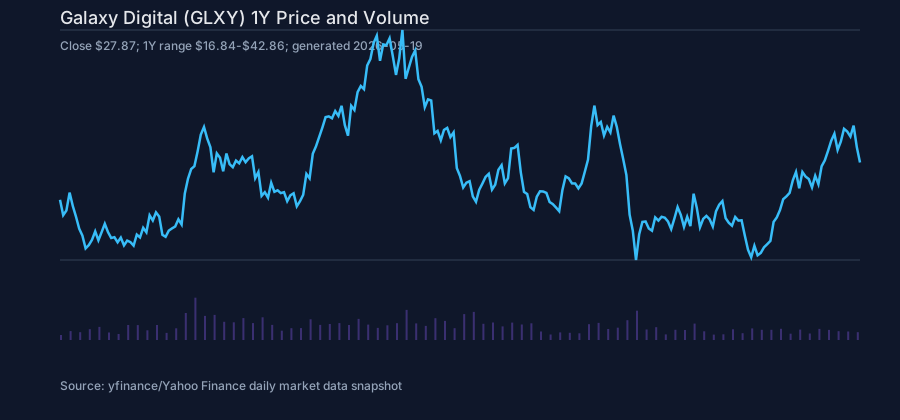
| 52-week low / high | $16.43 / $45.92 |
| Average daily volume | 5,407,814 shares |
| Approx. dollar volume | $150.7M/day |
| Beta | 3.65 |
| P/B | 3.0x |
| Consensus target mean | $42 across 16 opinions via yfinance/Yahoo snapshot |
Return / Drawdown Profile
| Period | Return |
|---|---|
| 1 month | 7.9% |
| 3 months | 30.8% |
| 6 months | 2.3% |
| YTD | 12.6% |
| 1 year | 17.8% |
Entry Discipline
Galaxy is a “buy the proof, not the promise” equity. The proof has improved since April, but the price has not reset enough to make the risk/reward asymmetrically attractive. The best underwriting setup is either:
- Pullback entry: accumulate below $24-25, where price/book and downside to crypto volatility are less punitive; or
- Confirmation entry: pay current or higher prices only after Q2 shows Helios revenue ramp, stable liquidity, and no deterioration in crypto-platform economics.
Catalyst / Risk Tracker
| Catalyst or risk | Watch item | Expected impact |
|---|---|---|
| Q2 2026 results | Helios revenue contribution and Phase I completion | Positive if delivery converts into visible revenue/margins |
| Additional 830 MW tenanting | New hyperscale contracts | Major positive if economics are attractive |
| Crypto market direction | Bitcoin/ETH drawdown or rally | Direct impact on earnings, book value, sentiment |
| Share repurchases | Continuation after Q1 $65M buyback | Positive if done below intrinsic value |
| Financing | Additional debt/equity for Helios expansion | Positive if project-level and non-dilutive; negative if common equity issued under pressure |
Final Updated Thesis
The April report was right to be cautious, but the May evidence nudges Galaxy from “too speculative at the price” to “credible watchlist with a selective entry.” Helios execution is the main reason the score improves. The Q1 loss is the main reason the score does not improve more. For Dave’s direct question: waiting is still more advantageous than buying a full position now. If we want exposure, buy a small starter and keep dry powder for the pullback or the Q2 proof point.