Nakamoto Inc. (NASDAQ: NAKA) Public Research Report
Cipher Research score: 49/100 Verdict: Pass / Watchlist Only Confidence: Medium Analyst: Cipher Research Date: May 19, 2026 Company: Nakamoto Inc. Ticker: NASDAQ: NAKA
Recent Market Update
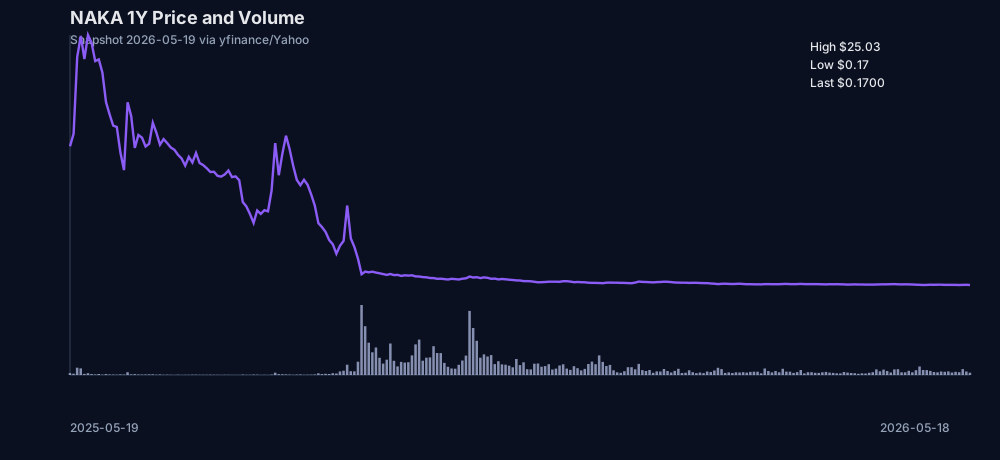
Nakamoto is now a public Bitcoin operating company built from the former KindlyMD public shell, Nakamoto Holdings, and the February 2026 acquisitions of BTC Inc. and UTXO Management. The current equity setup is not a clean Bitcoin proxy. As of the yfinance/Yahoo snapshot captured May 19, 2026, NAKA traded at roughly $0.17, down about 99% over one year, against a 52-week range of $0.16-$34.77. Nakamoto's own Q1 2026 materials reported $2.7 million of operating revenue, a $238.8 million net loss, 690.0 million shares outstanding, and 892.7 million fully diluted shares outstanding as of March 31, 2026. The public market is not just discounting Bitcoin volatility. It is discounting dilution, resale pressure, governance complexity, and the credibility of the operating-company rollup.
Direct view: NAKA is interesting only as a high-risk special situation if the discount to Bitcoin-adjusted asset value persists and management proves it can create BTC-per-share accretion without destroying minority holders. It is not investable on ordinary public-equity quality today.
Sources Reviewed
- Nakamoto company website
- Nakamoto About page
- Nakamoto investor relations
- Nakamoto management team
- Nakamoto Q1 2026 results press release
- Nakamoto FY2025 results and Bitcoin strategy update
- KindlyMD/Nakamoto merger completion announcement
- Nakamoto agreement to acquire BTC Inc. and UTXO Management
- SEC company submissions for CIK 0001946573
- Nakamoto Q1 2026 Form 10-Q
- Nakamoto FY2025 Form 10-K
- Nakamoto DEF 14A filed April 17, 2026
- Nakamoto 424B3 resale prospectus filed April 24, 2026
- Nakamoto ATM prospectus filed April 24, 2026
- David Bailey Schedule 13D filed February 27, 2026
- BitcoinTreasuries Nakamoto profile
- Galaxy Research on Bitcoin treasury company NAV premiums
- NYDIG research on crypto-treasury NAV premiums
- Bitcoin Magazine Pro public treasury-company tracker
- The Defiant coverage of the BTC Inc. / UTXO related-party concerns
- Cipher Research yfinance/Yahoo market-data snapshot captured locally on May 19, 2026.
Section 1: Summary of the Opportunity
Nakamoto Inc. is a Bitcoin operating company that owns Bitcoin and is trying to build a portfolio of Bitcoin-native businesses across media, events, asset management, advisory and treasury services. The pitch is straightforward: public equity investors get exposure to a Bitcoin-denominated balance sheet plus operating businesses that may create proprietary deal flow and Bitcoin treasury infrastructure. The problem is equally straightforward: the vehicle has already created a brutal minority-shareholder experience, with extreme drawdown, very large resale/ATM capacity, related-party optics around BTC Inc. and UTXO, and operating revenue that is still tiny relative to balance-sheet volatility.
| Item | Cipher Research view | Evidence |
|---|---|---|
| Business model | Bitcoin treasury plus Bitcoin-native operating company | Nakamoto About, Q1 2026 release |
| Public shell origin | KindlyMD merger with Nakamoto Holdings | Merger completion announcement |
| Core operating assets | BTC Inc., Bitcoin Magazine / Bitcoin Conference, UTXO Management | Acquisition announcement |
| Bitcoin holdings | 5,342 BTC at Dec. 31, 2025 per 10-K; BitcoinTreasuries reported 5,058 BTC | FY2025 10-K, BitcoinTreasuries |
| Q1 2026 revenue | $2.7 million total operating revenue | Q1 2026 release |
| Q1 2026 net loss | $238.8 million, heavily fair-value / transaction-driven | Q1 2026 release |
| Market snapshot | $0.17 share price, $118.3 million market cap, $291.7 million enterprise value | Cipher yfinance/Yahoo snapshot, May 19, 2026 |
| Initial recommendation | Pass / Watchlist Only | Cipher Research assessment |
Key underwriting tension: if the market cap remains far below the value of BTC holdings net of debt, there may be asset-value optionality. But the equity only becomes compelling if that value is accessible to common shareholders after debt, dilution, resale pressure, warrants/options/RSUs and governance risks.
Section 2: Market Opportunity Analysis
The relevant market is not simply “Bitcoin.” It is public Bitcoin treasury vehicles and Bitcoin-native operating infrastructure. That market expanded quickly in 2025-2026 as companies tried to replicate the Strategy playbook: issue public equity/debt at a premium to Bitcoin NAV, buy more Bitcoin, and compound BTC per share. Galaxy describes the core mNAV logic: a public company trading above its Bitcoin NAV can issue accretively and buy more BTC per share. NYDIG similarly highlights that the sector has proliferated, with multiple companies using equity lines, ATMs and convertibles to buy crypto assets.
| Market layer | Opportunity | Nakamoto fit | Evidence quality |
|---|---|---|---|
| Bitcoin as treasury reserve asset | Large, liquid, global asset with institutional adoption | Direct, but fully exposed to BTC drawdowns | Strong, public market evidence |
| Public Bitcoin treasury stocks | Investors seek equity wrappers with financing leverage and potential mNAV premium | Direct, but NAKA currently trades like a broken wrapper | Strong, market and SEC evidence |
| Bitcoin media/events | Bitcoin Magazine and Bitcoin Conference provide brand/distribution | Relevant operating differentiation | Moderate, company-provided and visible brand evidence |
| Asset management/advisory | UTXO and treasury advisory could monetize deal flow | Plausible but disclosure is thin | Weak to moderate |
| Healthcare legacy operations | KindlyMD legacy business remains small/non-core | Low strategic relevance | Strong but not material |
TAM/SAM/SOM discipline: Nakamoto has not provided a credible independently verified SAM/SOM for its exact combination of treasury, media, asset management and advisory. The more useful market test is whether it can grow BTC per share and operating earnings per share. On that test, evidence is still early and mixed.
Section 3: SWOT Analysis
| Strengths | Weaknesses |
|---|---|
| Holds a meaningful Bitcoin position, with FY2025 10-K disclosing about 5,342 BTC and BitcoinTreasuries reporting 5,058 BTC. | Operating revenue remains tiny at $2.7 million in Q1 2026 versus massive BTC fair-value volatility and a $238.8 million Q1 net loss. |
| BTC Inc. / Bitcoin Magazine / Bitcoin Conference give Nakamoto genuine Bitcoin ecosystem distribution. | Very large share count, fully diluted overhang and resale/ATM capacity make common-share economics hard to underwrite. |
| David Bailey and team are highly visible Bitcoin-native operators, not generic corporate tourists. | Related-party optics: CEO-linked BTC Inc. and UTXO assets were acquired by the public company, which The Defiant flagged as governance-sensitive. |
| Market cap at the snapshot appears below a simple BTC-holdings gross value estimate, creating possible special-situation optionality. | Stock down roughly 99% over one year and near its 52-week low, which indicates market distrust rather than mere macro volatility. |
| Opportunities | Threats |
|---|---|
| If NAKA can issue equity only when accretive to BTC per share, it could rebuild credibility as an mNAV compounder. | A continued BTC drawdown could pressure Nasdaq listing, book value, debt coverage and investor appetite. |
| BTC media/events could produce proprietary deal flow and advisory mandates in the Bitcoin treasury market. | Resale registration and ATM capacity can create persistent supply overhang. |
| Industry mNAV research supports a bull case for treasury companies when equity trades at durable premiums to NAV. | If NAKA trades below NAV, the ATM/flywheel mechanism becomes dilutive or unusable. |
| BTC Inc. and UTXO may diversify the story beyond passive BTC holding. | Conflicts, dilution, weak unit economics or unproven advisory monetization can swamp asset-value upside. |
Section 4: Competitive Landscape
Nakamoto competes with other public Bitcoin treasury companies, Bitcoin infrastructure companies, and asset managers/media businesses. It is not in a blue ocean. The category is crowded, reflexive and increasingly benchmarked on BTC per share, mNAV, financing cost, governance and liquidity.
| Competitor / comparable | Category | Why it matters | Nakamoto position |
|---|---|---|---|
| Strategy / MSTR | Largest public Bitcoin treasury company | Defines the public-equity Bitcoin treasury playbook | NAKA is much smaller and far less proven |
| Metaplanet | Japanese Bitcoin treasury company | International BTC treasury comp, high market attention | NAKA has US listing and operating assets, but weaker stock performance |
| Semler Scientific | US public company with Bitcoin treasury strategy | Shows non-crypto operating company pivoting to BTC | NAKA is more Bitcoin-native but more diluted/complex |
| Twenty One / other Bitcoin treasury vehicles | Bitcoin-native public wrappers | Compete for investor mindshare and financing access | NAKA's brand helps, but market trust is impaired |
| Bitcoin-native media/events platforms | Media/community/distribution | Compete for audience and sponsorship dollars | BTC Inc. gives NAKA a credible position |
| Crypto asset managers/advisers | Funds/advisory | Compete for institutional mandates | UTXO provides credibility, but public disclosure is thin |
Intensity assessment: Red Ocean for capital-markets attention, yellow/red for Bitcoin operating infrastructure. Nakamoto's differentiator is ecosystem distribution plus a treasury strategy. That is not enough without shareholder-friendly execution.
Section 5: Risk Analysis
| Severity | Category | Description | Likelihood | Impact | Mitigation / diligence need |
|---|---|---|---|---|---|
| 1 | Dilution / overhang | SEC filings include large resale capacity, pre-funded warrants, options/RSUs and a multi-billion-dollar ATM prospectus. | High | High | Track actual issuance, BTC per share and fully diluted share count monthly. |
| 2 | Bitcoin price exposure | BTC fair-value swings drove large losses and can pressure equity value, debt coverage and listing perception. | High | High | Stress test BTC at $40k, $60k, $80k, $100k and include debt/dilution. |
| 3 | Governance / related-party optics | BTC Inc. and UTXO acquisitions involve assets linked to CEO David Bailey, creating buyer/seller/control optics. | Medium | High | Review fairness opinions, independent committee process and post-deal disclosures. |
| 4 | Broken mNAV flywheel | Treasury-company models work best when equity trades above NAV; NAKA's stock collapse undermines accretive issuance. | High | High | Require proof of BTC-per-share accretion, not headline BTC accumulation. |
| 5 | Operating execution | Media, events, advisory and asset management may not generate enough earnings to justify complexity. | Medium | Medium | Segment revenue, margin and cash-flow disclosure needed. |
| 6 | Liquidity / listing | A low share price near 52-week lows raises reverse-split and listing-risk questions. | Medium | Medium | Monitor Nasdaq notices, split proposals and minimum-bid compliance. |
| 7 | Regulatory / custody | Bitcoin custody, treasury yield and derivatives strategies can introduce operational and regulatory risks. | Medium | High | Need custody, counterparty, collateral, derivatives and risk-limit detail. |
| 8 | Legacy healthcare distraction | The original KindlyMD business is strategically non-core and small. | Medium | Low | Clarify whether it will be sold, wound down, or retained. |
Section 6: Team Evaluation
David Bailey is a credible Bitcoin-native operator. Nakamoto IR states he co-founded BTC Inc. in 2013 and built Bitcoin Magazine and Bitcoin Conference properties. It also states he is co-founder and General Partner at UTXO Management. This is genuine domain depth. Tyler Evans is presented as CIO leading origination and investment strategy. The issue is not whether the team knows Bitcoin. It is whether the public-company structure protects minority shareholders while entities associated with insiders are folded into the public company.
| Executive / group | Evidence | Cipher assessment |
|---|---|---|
| David Bailey, CEO and Chairman | Nakamoto IR: co-founded BTC Inc., Bitcoin Magazine / Bitcoin Conference, UTXO Management | Strong Bitcoin credibility; governance optics require scrutiny |
| Tyler Evans, CIO | Nakamoto IR: investment strategy / origination | Relevant but public track-record disclosure limited |
| Board / management after merger | Merger completion announcement references new directors | Needs full independence and conflict-process review |
| Legacy KindlyMD management | Healthcare origin, now non-core | Not central to current thesis |
Credibility score: 3.5/5. Domain credibility is high. Public-company governance credibility is not yet high enough.
Section 7: Financial and Valuation Assessment
Public-market stock snapshot
| Metric | Snapshot | Source |
|---|---|---|
| Last price | $0.17 | Cipher yfinance/Yahoo snapshot, May 19, 2026 |
| Market cap | $118.3 million | Cipher yfinance/Yahoo snapshot, May 19, 2026 |
| Enterprise value | $291.7 million | Cipher yfinance/Yahoo snapshot, May 19, 2026 |
| 52-week range | $0.16-$34.77 | Cipher yfinance/Yahoo snapshot, May 19, 2026 |
| Average volume | 5.15 million shares | Cipher yfinance/Yahoo snapshot, May 19, 2026 |
| Shares outstanding | 696.1 million in yfinance snapshot; 690.0 million per company at Mar. 31, 2026 | Q1 2026 release, Cipher yfinance/Yahoo |
| Fully diluted shares | 892.7 million at Mar. 31, 2026 | Q1 2026 release |
| Total debt | $209.7 million | Cipher yfinance/Yahoo snapshot |
| Cash | $35.3 million | Q1 2026 Form 10-Q and Cipher yfinance/Yahoo |
| One-year return | About -98.8% | Cipher yfinance/Yahoo snapshot |
Financials
Q1 2026 was not an ordinary operating quarter. The company reported $2.7 million of operating revenue, but net loss was $238.8 million, driven by Bitcoin mark-to-market, transaction-related items and non-cash fair-value items. FY2025 revenue was small, and legacy healthcare revenue is not the current investment story.
| Item | Reported figure | Interpretation |
|---|---|---|
| Q1 2026 revenue | $2.7 million | Too small to anchor valuation |
| Q1 2026 net loss | $(238.8) million | Dominated by BTC and transaction/fair-value effects |
| Q1 2026 cash | $35.3 million | Limited versus debt and volatility |
| Q1 2026 assets | $620.8 million | Largely BTC / acquired asset driven |
| Q1 2026 liabilities | $253.7 million | Debt and liabilities matter for NAV math |
| Q1 2026 equity | $367.1 million | Above current market cap snapshot, but quality/liquidity uncertain |
NAV sensitivity
Using the 5,058 BTC figure from BitcoinTreasuries and $35.3 million cash less $209.7 million debt, simple net treasury value changes sharply with Bitcoin price.
| BTC price | Gross BTC value | Add cash | Less debt | Simple net treasury value | Per 690.0M shares | Per 892.7M diluted shares |
|---|---|---|---|---|---|---|
| $50,000 | $252.9M | $35.3M | $(209.7)M | $78.5M | $0.11 | $0.09 |
| $75,000 | $379.4M | $35.3M | $(209.7)M | $205.0M | $0.30 | $0.23 |
| $100,000 | $505.8M | $35.3M | $(209.7)M | $331.4M | $0.48 | $0.37 |
| $125,000 | $632.3M | $35.3M | $(209.7)M | $457.9M | $0.66 | $0.51 |
This table explains the watchlist case: at the current $0.17 snapshot price, the equity may screen below simple BTC-adjusted value at BTC prices around $75k and above. It also explains the pass: simple NAV is not the same as realizable common-share value when dilution, resale pressure, governance and operating burn are unresolved.
Section 8: Go-to-Market Strategy and Traction
Nakamoto's go-to-market strategy appears to be: use BTC Inc. media/events for brand and distribution, use UTXO for investment/advisory origination, use the public listing for capital markets access, and use the Bitcoin treasury as both balance-sheet reserve and strategic currency.
| Traction item | Evidence | Quality rating | Cipher view |
|---|---|---|---|
| Bitcoin treasury established | 5,342 BTC at year-end 2025, BitcoinTreasuries 5,058 BTC profile | Strong | Real asset base |
| BTC Inc. acquisition | Company announced definitive agreement and completion | Strong for transaction occurrence | Operating economics still thin |
| UTXO Management acquisition | Company announced definitive agreement and completion | Strong for transaction occurrence | Economics / AUM / fees need detail |
| Q1 2026 revenue | $2.7 million total operating revenue | Strong | Very early relative to valuation volatility |
| Derivatives/yield strategy | Company says $1.1 million from Bitcoin treasury and derivatives strategy | Moderate | Need risk limits, counterparties and repeatability |
| Advisory / treasury services | Company claims global portfolio and advisory flywheel | Weak to moderate | Needs customer/revenue proof |
Section 9: Additional Considerations
- Regulatory: Bitcoin treasury, derivatives/yield strategies and asset-management/advisory activities create securities, custody, counterparty and disclosure risks.
- Accounting: Fair-value treatment creates earnings volatility that can swamp operating performance.
- Custody: Public-company BTC custody arrangements need explicit verification, including custodians, insurance, counterparty concentration and internal controls.
- Related-party governance: The acquisition of assets associated with leadership is a central diligence item, not a footnote.
- Exit / re-rating path: Re-rating requires visible BTC-per-share growth, disciplined issuance, segment profitability, a cleaner cap table and reduced overhang.
- Ethical / investor-protection issue: A retail-accessible Bitcoin wrapper with extreme volatility and dilution capacity needs especially clear disclosures.
Section 10: Research and External Validation
Claims supported externally
- Nakamoto is a public Bitcoin company with Bitcoin-native operating assets. Supported by Nakamoto website, SEC filings and press releases.
- Nakamoto held thousands of BTC. Supported by FY2025 10-K and BitcoinTreasuries.
- Q1 2026 financials were highly volatile. Supported by Form 10-Q and company Q1 release.
- BTC Inc. and UTXO are central to the operating-company strategy. Supported by Nakamoto acquisition announcement and IR management biographies.
- Bitcoin treasury-company valuation is commonly analyzed through BTC NAV / mNAV. Supported by Galaxy and NYDIG research.
Claims contradicted or not yet proven
- “Operating company flywheel” is not yet proven by segment economics. Revenue is too small and disclosure too limited.
- “Accretive capital markets engine” is contradicted by current market price collapse and likely inability to issue accretively at depressed prices.
- “Diversification beyond Bitcoin” is only partly true; earnings and asset value remain heavily BTC-linked.
- “Shareholder-aligned rollup” remains unproven given related-party optics and large dilution overhang.
Information gaps
- BTC custody terms, counterparties, insurance and collateral controls.
- Detailed BTC-per-share calculation over time on basic and fully diluted bases.
- Segment revenue/margin for BTC Inc., UTXO, advisory, treasury strategy and legacy healthcare.
- Actual post-quarter issuance under resale registrations or ATM.
- Independent committee / fairness process details for related-party-linked acquisitions.
- Derivatives/yield strategy limits, drawdown controls and counterparty exposures.
- Customer list or mandate evidence for treasury advisory.
Section 11: Investment Recommendation
Verdict: Pass / Watchlist Only ❌ / ⚠️ Confidence: Medium
Top 3 reasons to continue watching
- Asset-value setup: Current market cap appears meaningfully below a simple estimate of BTC-adjusted value at mid/high BTC prices.
- Real Bitcoin ecosystem assets: BTC Inc., Bitcoin Magazine, Bitcoin Conference and UTXO are more credible than a generic shell-company Bitcoin pivot.
- Potential re-rating trigger: If management proves BTC-per-share accretion and reduces overhang, the equity could re-rate sharply from distressed levels.
Bottom 3 reasons to be skeptical
- Dilution/overhang dominates: Large resale capacity, warrants/options/RSUs, fully diluted share count and ATM capacity make common-share economics hard to trust.
- Governance risk is central: CEO-linked BTC Inc. and UTXO acquisitions require unusually high conflict-process transparency.
- Operating proof is thin: $2.7 million Q1 revenue cannot yet justify the complexity, debt, volatility or public-market story.
Priority DD questions
- What is the fully diluted BTC-per-share trend since merger closing, including all warrants, RSUs, options, holdbacks and potential ATM issuance?
- How many shares have been sold by PIPE/resale holders since effectiveness, and who remains locked up?
- What independent committee process and fairness analysis supported the BTC Inc. and UTXO acquisitions?
- What are BTC custody arrangements, counterparties, insurance, wallet controls and collateral encumbrances?
- What are the exact terms of debt and convertibles, including covenants, maturities, conversion prices and BTC collateral exposure?
- What revenue, gross margin and EBITDA did BTC Inc. and UTXO contribute separately in Q1 and expected FY2026?
- What is the risk policy for Bitcoin derivatives/yield strategies, including VaR, loss limits and counterparty limits?
- Does management commit to no equity issuance below BTC-adjusted NAV per share unless required for survival?
- What is the plan for the legacy healthcare business?
- Is a reverse split likely, and how would it affect liquidity and retail investor perception?
Section 12: Cap Table Analysis & Dilution Modeling
Nakamoto is a one-share/one-vote common-stock story based on reviewed proxy language, but the economic overhang is substantial.
| Cap-table item | Disclosure / estimate | Diligence implication |
|---|---|---|
| Common shares outstanding at record date / Q1 | 690,018,254 | Very high share count |
| yfinance shares outstanding snapshot | 696,085,586 | Close to company Q1 disclosure, suggests continued updates needed |
| Fully diluted shares at Mar. 31, 2026 | 892,723,519 | Large dilution gap |
| Options outstanding | 78,714,493 shares per proxy snippet | Material dilution |
| RSUs reserved/vesting | 17,636,822 shares per proxy snippet | Material compensation overhang |
| Pre-funded warrants | 61,704,975 shares per proxy / prospectus | Material financing overhang |
| Tradable warrants | 384,936 shares per proxy/prospectus | Small relative to total |
| Non-tradable warrants | 101,783 shares per proxy/prospectus | Small relative to total |
| Resale prospectus | Up to 351,649,826 shares plus 61,704,975 warrant shares in one April 2026 424B3 | Major supply overhang |
| ATM prospectus | Up to about $4.99 billion of common stock under sales agreement | Potentially huge, only accretive if issued above NAV |
| David Bailey Schedule 13D | Bailey reported beneficial ownership after merger/acquisition-related consideration | Control/alignment and related-party review required |
Exit / dilution framing
Traditional startup waterfall tables are not the right tool for a public Bitcoin treasury company. The relevant dilution model is BTC-adjusted NAV per share under basic and fully diluted counts. Using 690.0 million basic shares and 892.7 million fully diluted shares, a $331 million simple net treasury value implies $0.48 per basic share but only $0.37 per fully diluted share. That gap is the investment story.
Section 13: Founder Deep-Dive
David Bailey is not a first-time crypto tourist. Nakamoto IR credits him with co-founding BTC Inc. in 2013 and building Bitcoin Magazine and Bitcoin Conference. He is also associated with UTXO Management. That background supports the positive side of the thesis: real distribution, network and Bitcoin-native deal flow.
The same facts create the negative side. When a public company led by Bailey acquires BTC Inc. and UTXO, assets linked to Bailey, minority investors need unusually strong governance disclosure. The Defiant coverage explicitly flagged the “buyer, seller and CEO” optics. Cipher Research treats that as a diligence red flag, not proof of wrongdoing.
| Founder / leader item | Positive evidence | Red flag / gap |
|---|---|---|
| Bitcoin domain experience | BTC Inc., Bitcoin Magazine, Bitcoin Conference, UTXO | Could create conflicts when assets are internalized |
| Public-company CEO role | Leads Nasdaq-listed Bitcoin vehicle | Public-company track record still short |
| Network / deal flow | Strong Bitcoin community visibility | Needs translated economics and shareholder alignment |
| Litigation / controversy search | No definitive litigation finding from captured sources | Related-party public criticism requires response and governance proof |
Section 14: Quantitative Scoring Model
| Dimension | Weight | Score | Weighted contribution | Rationale |
|---|---|---|---|---|
| Team | 25% | 6.5 | 16.25 | Strong Bitcoin-native credibility, governance questions cap score |
| Market | 20% | 7.0 | 14.00 | Bitcoin treasury market has real demand, but reflexive and crowded |
| Traction | 20% | 3.5 | 7.00 | BTC assets real, operating revenue tiny and equity performance terrible |
| Financials | 15% | 3.5 | 5.25 | Possible NAV discount, but large losses, debt and weak operating economics |
| Competitive | 10% | 4.5 | 4.50 | Differentiated media/assets, but red-ocean Bitcoin treasury market |
| Risk Profile | 10% | 2.0 | 2.00 | Dilution, governance, BTC volatility, listing/liquidity risks are severe |
| Total | 100% | 49.0 | Pass / Watchlist Only |
Score: 49/100. Below the 50 borderline threshold because investability is blocked by overhang and governance risk. The asset-value setup prevents a lower score.
Section 15: Stage-Specific Benchmarking
Nakamoto is public, not venture-stage SaaS, so standard seed/Series A ARR benchmarks are not directly applicable. Still, the comparison is useful because it shows how little recurring operating proof exists relative to public-market complexity.
| Benchmark lens | Benchmark | NAKA evidence | Assessment |
|---|---|---|---|
| Pre-seed / seed revenue | $0-$100k ARR typical | Q1 2026 revenue $2.7M | Revenue exists, but not SaaS ARR |
| Series A revenue quality | $1.5M ARR, 70% gross margin, clear unit economics | No clear recurring ARR / gross margin by segment | Not comparable / unproven |
| Series B quality | $8M ARR, NDR, repeatable GTM | No NDR/CAC/payback disclosure | Not proven |
| Public BTC treasury benchmark | BTC per share growth, mNAV, issuance discipline | BTC holdings real; BTC-per-share and issuance quality unclear | Needs monthly proof |
| Burn multiple | <1.5x best-in-class, >3.0x deal killer for SaaS | Not meaningful due BTC fair-value swings | Use cash burn and BTC-per-share instead |
Best benchmark: BTC-per-share accretion, net treasury value per diluted share, and segment EBITDA. Nakamoto has not yet earned a clean score on those measures.
Section 16: Comparable Transactions Analysis
| Company / vehicle | Transaction / strategy | Round / capital | Valuation / market reference | Key investors / banks | Date |
|---|---|---|---|---|---|
| Nakamoto / KindlyMD | Merger plus PIPE to fund Bitcoin treasury | $540M PIPE at closing; company/press cited $763M including convertible notes | Public NAKA equity subsequently collapsed | Cohen & Company Capital Markets and others involved | 2025 |
| Strategy | Ongoing debt/preferred/equity issuance to buy BTC | Multi-year capital markets program | Trades around BTC NAV / premium depending period | Broad public-market investor base | Ongoing |
| Metaplanet | Bitcoin treasury accumulation in Japan | Large announced financing programs | Public Japanese BTC treasury comp | Public market / financing partners | 2025-2026 |
| Semler Scientific | Healthcare company with Bitcoin treasury strategy | Public company balance sheet strategy | Smaller US comp | Public market | 2024-2026 |
| Twenty One / other BTC treasury vehicles | Bitcoin-native public wrappers | PIPE/SPAC-style financing | Early-stage public comps | Sponsor / PIPE investors | 2025-2026 |
The comparable set supports the existence of investor demand for Bitcoin treasury equities. It does not prove NAKA deserves a premium, especially after a 99% drawdown and heavy overhang.
Section 17: Unit Economics Deep-Dive
| Metric | Nakamoto disclosure | Cipher assessment |
|---|---|---|
| CAC | Not disclosed | Cannot assess |
| LTV | Not disclosed | Cannot assess |
| LTV/CAC | Not disclosed | Cannot assess |
| Payback period | Not disclosed | Cannot assess |
| Gross margin | yfinance snapshot shows negative gross-margin metric; segment margins not reliable enough | Needs segment disclosure |
| Burn multiple | Not meaningful under BTC fair-value accounting | Use cash burn and BTC-per-share accretion instead |
| Net Dollar Retention | Not disclosed | Not a SaaS-style business today |
| Magic Number | Not disclosed | Cannot assess |
| BTC per share | Not consistently disclosed across basic/fully diluted periods | Decisive missing metric |
| Derivatives/yield ROA | Q1 release references $1.1M from BTC treasury/derivatives strategy | Needs risk-adjusted returns and drawdown limits |
Bottom line: the operating unit economics are not investable yet. The only actionable economics are balance-sheet economics, and those are impaired by dilution, debt and governance uncertainty.
Public-Market Appendix
A. Trading snapshot
| Metric | Value |
|---|---|
| Last price | $0.17 |
| Market cap | $118.3M |
| Enterprise value | $291.7M |
| 52-week low | $0.16 |
| 52-week high | $34.77 |
| Average volume | 5.15M shares |
| Float shares | 431.0M |
| Shares outstanding | 696.1M snapshot / 690.0M company Mar. 31, 2026 |
| Fully diluted shares | 892.7M company Mar. 31, 2026 |
B. Historical return / drawdown profile
| Period | Return |
|---|---|
| 1 month | -30.0% |
| 3 months | -32.8% |
| 6 months | -72.3% |
| YTD | -58.3% |
| 1 year | -98.8% |
C. Valuation bridge
| Bridge item | Value / interpretation |
|---|---|
| Gross BTC value | Depends on BTC price and current BTC count; BitcoinTreasuries reported 5,058 BTC |
| Cash | $35.3M at Q1 2026 |
| Debt | $209.7M snapshot / company EV bridge showed notes payable around $210M |
| Market cap | $118.3M snapshot |
| Core question | Is the discount to simple net treasury value real and accessible to common holders? |
| Cipher answer | Possibly, but not enough to offset overhang/governance risk today |
D. Catalyst / risk tracker
| Catalyst / risk | Direction | Watch item |
|---|---|---|
| BTC price recovery | Positive | Net treasury value and sentiment |
| BTC-per-share accretion disclosure | Positive if proven | Monthly basic/diluted BTC per share |
| Reduction of overhang | Positive | Resale exhaustion, insider holding, lockups |
| Segment profitability | Positive | BTC Inc. / UTXO EBITDA |
| ATM issuance below NAV | Negative | Dilution without BTC-per-share accretion |
| Related-party backlash | Negative | Governance process, litigation, shareholder votes |
| Nasdaq minimum-bid issue | Negative | Reverse split / compliance notices |
E. Entry discipline conclusion
Do not buy NAKA solely because it screens below gross Bitcoin value. The correct watchlist trigger is a package: (1) current BTC holdings verified, (2) no material unpriced dilution, (3) credible BTC-per-share accretion, (4) clearer governance around BTC Inc. / UTXO, and (5) evidence that operating assets can generate cash rather than just narrative.
Investable threshold: consider only after management proves BTC-per-share accretion and the equity trades at a discount to conservative diluted net treasury value after debt and expected dilution.